
Outdoor living
Awnings
Patio, retractable, cassette and motorised awnings for shading terraces and sun-facing glazing, specified only after we have seen the wall, the orientation and how exposed the site is.
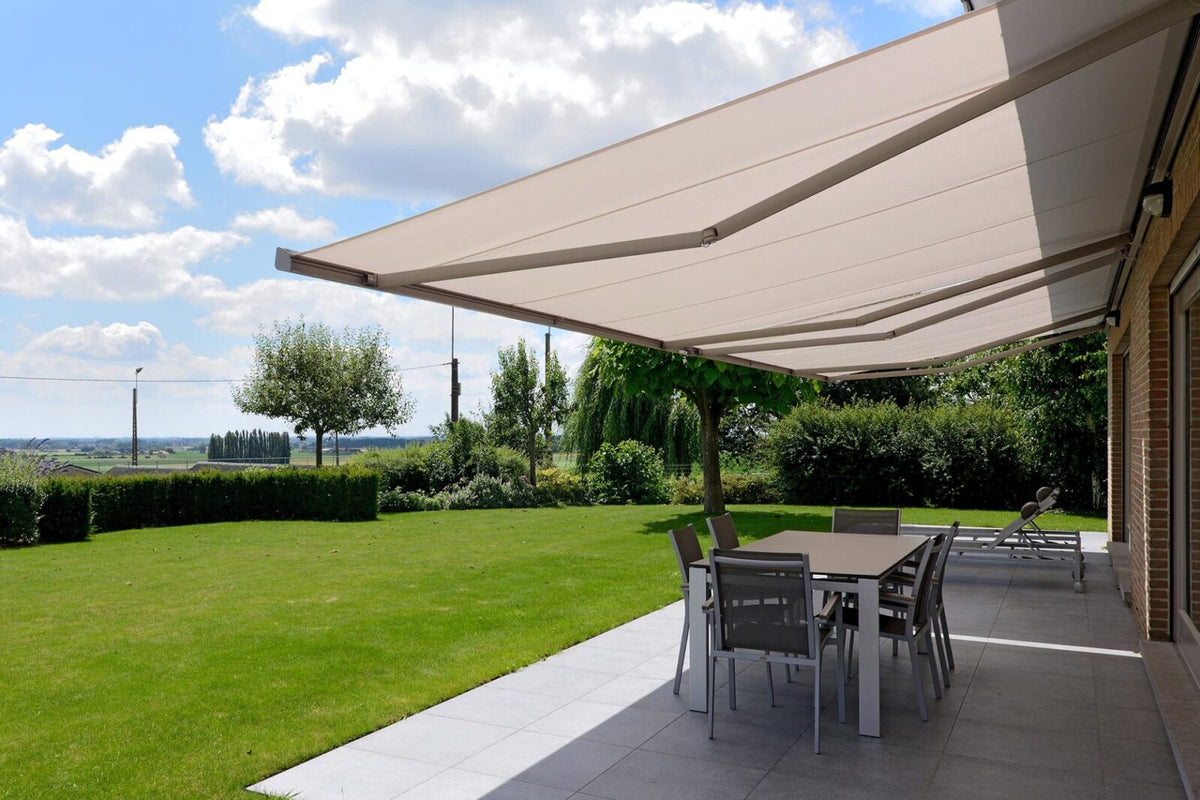
An awning gives you shade exactly where you sit: over a patio, a terrace or the glazing of a sun-facing room. Done well, it makes an outdoor space usable on bright afternoons and keeps some of the sun off the glass before it warms the room behind it. Done badly, it is the wrong size, fixed to the wrong wall, or left out in weather it was never meant for. This page explains the main types we can discuss with you, the questions that decide which one suits your home, and what we check at a site survey before recommending anything.
Jump to: Patio awnings · Retractable awnings · Full cassette awnings · Electric awnings and motorisation · Commercial awnings · What we check on site
Patio awnings
Most residential enquiries are for a patio awning: a fabric canopy fixed to the house wall above a door or window that projects out over a seating area. The useful questions are simple. Where do you sit, and at what time of day? Which way does the patio face? How far out does the shade need to reach to cover the table rather than just the doorstep? A west-facing terrace used for evening meals needs different coverage from a south-facing patio used at lunchtime, because later in the day the sun is lower and comes in at a flatter angle.
Awnings are sun shading. They are not designed as permanent rain shelters or as a roof over a space, and they should not be relied on in strong wind. If what you really need is year-round cover, tell us, because an awning may not be the right answer.
Retractable awnings
Almost every domestic awning is retractable: the fabric rolls back onto a bar against the wall when not in use, and folding arms extend it out when you want shade. Being able to retract it matters. It lets you enjoy the sun when you want it, keeps light coming into the room on dull days, and means the awning can be brought in when the weather turns. How well it copes when it is extended depends on the system, the projection, the fixings and the exposure of the site, which is why we would not quote a wind rating without knowing the exact product and location.
Retractable awnings broadly come in open designs, where the rolled fabric and arms sit exposed on the wall, and designs that enclose them to a greater or lesser extent. That leads to the most common question we are asked about type.
Full cassette awnings
A full cassette awning closes into a housing when retracted, so the fabric and folded arms are enclosed rather than left exposed on the wall. The appeal is a tidier appearance and more protection for the fabric and mechanism when the awning is not in use. Semi-cassette and open designs leave more of the fabric or mechanism visible and may suit a sheltered position or a simpler brief. Which approach is right depends on how exposed the wall is, how often you will use the awning, how visible it is from the house and the garden, and what the particular system allows. Sizes, projections, frame colours and fabric choices are all system specific, and we confirm them at survey rather than promising them on a web page.
Electric awnings and motorisation
Larger awnings can be heavy to wind out by hand, and many people prefer to operate them with a switch or remote. Motorised operation is available on selected systems. Depending on the system, it may be possible to add sensors that respond to sun or wind, and on some systems extras such as integrated lighting or heating can be discussed. None of that is universal, so we only recommend features the chosen system genuinely supports, and we explain what each one does and does not do.
Two points are worth knowing before you decide. First, a motorised awning needs a power supply near the fixing position, which is something to plan with your electrician. Second, a wind sensor is a helpful safeguard but not a substitute for common sense: an awning should still be retracted when bad weather is forecast or when you are away from home. If you are also looking at motorised blinds indoors, see our motorised blinds page.
Commercial awnings
Awnings are also used by cafés, pubs, shops and other businesses to shade outdoor seating or a shopfront. Commercial projects raise extra questions: how often the awning will be operated and by whom, whether branding is wanted on the fabric, what the landlord or building owner allows, and whether any permissions may need checking. We are happy to discuss commercial awning enquiries where they fit alongside a wider shading project; start with our commercial page and tell us about the site.
What we check on site
- The fixing wall. An extended awning puts real load on its brackets. We look at the wall construction, its condition and what sits above and around the fixing position, such as gutters, soffits, window heads and cables. Some walls need special fixings or a different approach, and some are not suitable at all.
- Height and clearance. There needs to be enough height for the awning to project at a comfortable pitch with headroom underneath, and clearance from doors that open outward.
- Orientation. Which way the space faces decides when the sun reaches it and how far out the shade needs to go.
- Exposure to wind. Open, elevated or gusty sites need more careful thought, and in some places an awning is not the sensible choice.
- Power. For motorised systems, where a supply can be brought to the awning.
- Permissions. For listed buildings, conservation areas, flats, leasehold properties and commercial premises, planning or landlord consent may need checking before anything is ordered. We can flag when this might apply, but we are not able to give planning advice.
The final specification, including size, projection, fixings and controls, is confirmed at a site survey. We would rather tell you an awning is the wrong answer than fit one that will not cope with your site.
Awnings and heat inside the house
Because an awning shades the glass from outside, it can intercept sun before it passes through the glazing, which is generally more effective for heat than a blind inside the window. It only helps when it is extended and when the sun is at an angle it can block, so for rooms that overheat through the day it is worth comparing awnings with vertical external solar shading. Our heat and glare guide explains the difference. When you are ready, book a free survey and we will look at the space with you.
Other outdoor options
- External solar shadingVertical shading outside the glass for rooms that overheat
- External ZIP screensSide-guided vertical screens for windows and openings
- PergolasFramed outdoor shading for a defined seating area
- Heat and glareChoosing between internal and external solutions
- Solar screen blindsInternal screen fabrics for glare
- CommercialShading for businesses and larger projects
Questions we get asked
Free, no obligation
Tell us about your space
Send us a few details or book a visit. We will look at orientation, fixing and how you use the space, and tell you honestly what will work.
Ask about outdoor shadingVisit our showroom
Or call 01223 756519