
Outdoor living
External ZIP Screens
Vertical fabric screens fitted outside the glass, with the fabric edges held in side channels. A tidy way to take heat and glare off sun-facing windows and doors, where the site and fixings allow.
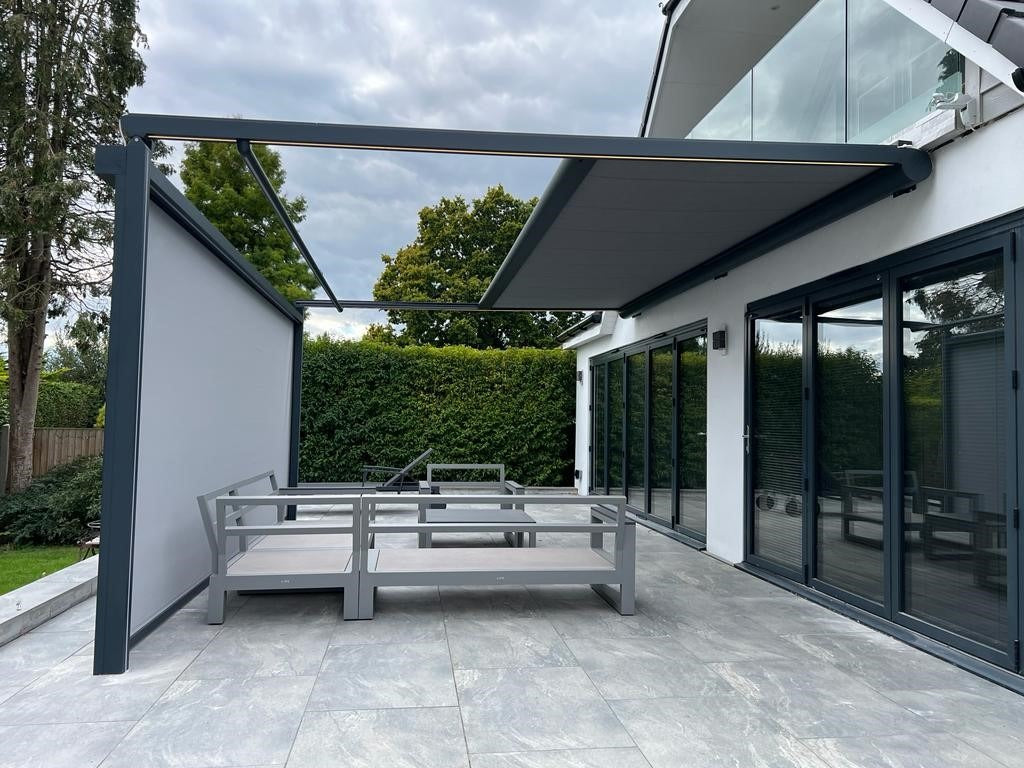
An external ZIP screen is a vertical fabric screen fitted outside a window or door, with the edges of the fabric retained in side channels rather than hanging free. Keeping the edges held in the guides helps the fabric stay flat and in place and reduces the gaps at the sides that a free-hanging screen would leave. The result is a clean, tensioned panel of fabric across the outside of the glass, which retracts into a head box when not needed.
ZIP screens are one type of external solar shading. This page covers where they suit, how they differ from other options, and the practical points we check before recommending one.
Where ZIP screens tend to work well
- Sun-facing windows and doors that overheat. Because the screen sits outside the glass, it intercepts the sun before it reaches the room. For low west sun in particular, a vertical screen often does more than an overhead awning.
- Large glazing. Bifold and sliding doors, garden rooms and extensions, where internal blinds would be large, and where you might prefer to keep the inside clear.
- Daytime privacy with a view out. Depending on the fabric, a screen can reduce how easily people see in during the day while you still see out. At night, with lights on inside, the effect reverses, so an internal blind or curtain may still be needed for evening privacy.
- Outdoor rooms. Some systems can be used on the open sides of a covered area to cut low sun and some wind, where the structure allows.
Where we might suggest something else
- North-facing rooms, where heat gain is rarely the issue and an internal blind is usually simpler.
- Where the main aim is darkness for sleeping: an internal blackout blind is the better starting point.
- Where external changes are restricted, for example on some listed buildings, conservation area properties or flats.
- Where there is no practical fixing position or safe access outside the opening.
Wind, weather and fixing
Retaining the fabric edge in the channels generally helps a screen cope with wind better than a free-hanging external blind, but no screen should be treated as storm-proof. How much wind a particular system can handle depends on the product, its size and the site, and we will explain the manufacturer's guidance for the system we recommend rather than quote a figure here. Many owners choose motorised operation with a wind sensor, where the system supports one, so the screen can retract automatically.
At survey we look at the head of the opening for a fixing position for the head box, the reveals or face of the wall for the side channels, and anything that might get in the way, such as sills, handles on outward-opening doors, cladding, render or downpipes. Some openings suit a recessed fit and others a face fit, and occasionally the head box is best planned into building work in advance.
Fabric choices
Screen fabrics vary in how open the weave is, which affects the view out, the privacy by day and how much light and heat is let through. Colour matters too: darker fabrics usually give a clearer view out, while lighter ones can look brighter from outside. We do not publish performance percentages because they depend on the exact fabric and system, but we can show you samples and explain the trade-offs. For internal equivalents, see solar screen blinds.
Controls and motorisation
Smaller screens may be operated manually on some systems, but motorised operation is common and is available on selected systems. It needs a power supply at the head box position, which is easiest to plan before decorating or during building work. Where supported, sun and wind sensors can raise or lower the screen automatically.
Size limits, fabrics, colours, controls and fixing details are system specific and are confirmed at a site survey. Book a free survey and we will tell you honestly whether a ZIP screen is the right answer.
Other outdoor options
Questions we get asked
Free, no obligation
Tell us about your space
Send us a few details or book a visit. We will look at orientation, fixing and how you use the space, and tell you honestly what will work.
Ask about outdoor shadingVisit our showroom
Or call 01223 756519