Bay Window Blinds

Bay windows reward accurate planning. Adjacent blinds need to meet cleanly at the corners while allowing for handles, mullions, sills, opening sashes and the depth of each blind.
Book a Free Home Survey Call 01223 756519

Bay Window Blinds

Strong options

  • Roman blinds, where softness is wanted and the stack positions work
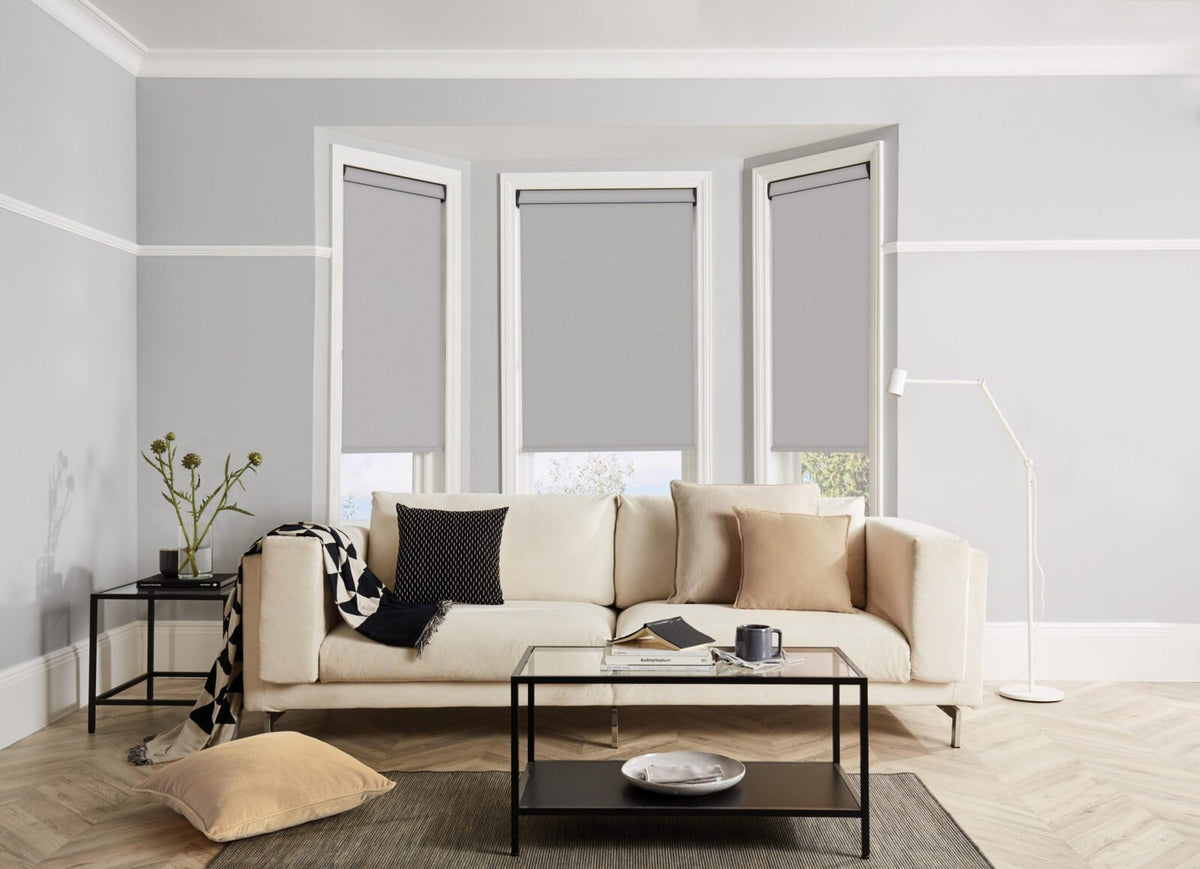
  • Roller blinds, for a clean treatment on each window
  • Wooden, faux wood or Venetian blinds, where adjustable privacy matters
  • Pleated and cellular blinds, for a compact profile
  • Shutters, for a more architectural solution

The corner problem

Headrails, brackets and blind depth can collide at the angles of a bay if each blind is specified on its own. We measure the exact angles and depth, handle positions and opening sashes, and agree where each blind meets and whether blinds sit inside or outside the recess.

Privacy

Street-facing bays often need privacy without losing daylight. Slatted blinds and shutters are particularly useful here.

Inside or outside the recess

Many bays have a deep reveal, which lets each blind sit neatly inside its own window. Others have shallow or uneven reveals, or handles that project into the space, and there face-fixing above the window or a frame-fitted Perfect Fit blind on each pane can work better. We decide this window by window.

Stack and light

When a blind is raised it has to go somewhere. A Roman blind stacks deeper than a roller, and a wooden blind stack can take a noticeable band of glass at the top of each window. In a bay with modest window heights that can matter, so we show you the stack size at the survey.

Bow windows

Curved bow windows follow the same principles with more, narrower sections. Each blind is measured individually and the gaps between them planned so they look even.

Made to measure and fitting

Every blind in the bay is made to its own measurement but specified as a set, so fabrics, colours, bottom bars and control sides match across the whole window.

Key features

Motorisation
Available on selected ranges

Honest suitability

Is it right for your window?

Every recommendation comes with a reason. Where something else would serve you better, we say so — and suggest what to consider instead.

Where this works well

  • Street-facing bays Recommended

    Slatted blinds or screen fabrics give privacy while letting in daylight.

  • Living room bays

    Roman or roller blinds matched across each window give a calm, finished look.

    Worth knowing: Roman blind stacks take up more glass when raised.

  • Bays with shallow reveals or projecting handles With conditions

    Face-fixed or frame-fitted blinds can avoid the problem.

    Worth knowing: We check handle positions and reveal depth on every window before specifying.

  • Curved bow windows Specialist survey

    Several narrow blinds can follow the curve.

    Worth knowing: Narrow sections leave more gaps and need careful measuring.

Where we’d suggest something else

  • One continuous blind across the bay

    Why: A single blind cannot turn the angle of a bay.

    The limitation: Each window needs its own blind.

    Consider instead: Bay window curtains

  • Bays where a permanent furniture-like finish is wanted

    Why: Blinds read as soft furnishing rather than joinery.

    The limitation: If you want the bay to feel built in, blinds may not give that look.

    Consider instead: Bay window shutters

Fabrics and finishes

Any fabric or slat finish we offer for a standard window can be used in a bay, as long as it suits the blind type. Matching the same fabric or finish across every window keeps the bay reading as one feature.

Moisture-suitable fabrics and faux-wood slats are available for kitchen bays; that choice depends on the specific fabric or material.

Controls

Chain, cord, wand, cordless or motorised operation, depending on blind type. In a bay we plan control sides so chains or wands do not clash where two blinds meet.

Motorisation can raise and lower all the blinds in a bay together, and is available on selected roller and other systems.

Child safety

Internal blinds supplied in the UK must meet child-safety requirements, following BBSA guidance, and the blinds we fit are supplied with the required safety devices.

A bay can mean several chains or cords in one area. Cordless and motorised options remove them; where chains are used, each one has its safety device fitted at the correct height. Window seats in bays are often climbed on, so keep controls well out of reach.

Compared with the alternatives

Bay window shutters

A more architectural, fitted look with adjustable louvres. A larger investment, and they need space to fold back.

Bay window curtains

The only real one-piece option, running on a bent track around the whole bay. Softer and warmer, but they take space at the sides.

Roman blinds

Soft folds on each window. The stack is deeper than a roller, so best where the windows are tall enough to spare it.

Wooden blinds

Adjustable slats for daytime privacy in street-facing bays. A heavier look and a larger stack.

Questions we get asked

Will there be gaps at the corners?

Some gap is usually needed so blinds can operate. Careful planning keeps it small and even.

Is one blind across the bay possible?

Usually each window gets its own blind. Curtains on a bay track are the main one-piece option.

Can different blind types be used in the same bay?

It is possible, but a bay usually looks best with the same type and fabric on every window. We may suggest a different option for a door or a window with an awkward handle.

Can bay window blinds be motorised?

Yes, on selected systems, and all the blinds can then be controlled together.

Free, no obligation

Book your Free Home Survey

We’ll measure properly, bring samples to see in your own light, talk you through what suits each window, and give you a no-obligation quotation.

Book a Free Home SurveyVisit our showroom

Or call 01223 756519